Settings & Privacy: the ethical redesign
of the dark patterns
And the story began…
In Q2 of 2023, the Customer Service team, together with IT and Legal teams, initiated an urgent project to comply with the CCPA (California Consumer Privacy Act) and CPRA (California Privacy Rights Act), which came into effect in March 2024. In light of these laws, the very outdated and hard-to-understand Settings & Privacy section on tivo.com needed a redesign.
I don’t even know why this project is so dear to my heart. Perhaps it's because anytime I visit a website or an app, an annoying widget pops up with privacy questions I don't quite understand, and I just hit 'Accept All' without knowing what I have just agreed to. Thus, I felt compelled to understand the nuances of Privacy Settings and to inform TiVo customers about them in an open, friendly, and compelling way.
If you have a TiVo.com account, you can view the implementation by going to the 'Manage My Account' section, under the 'Settings & Privacy' subsection.
Final shippd mockups
-
![]()
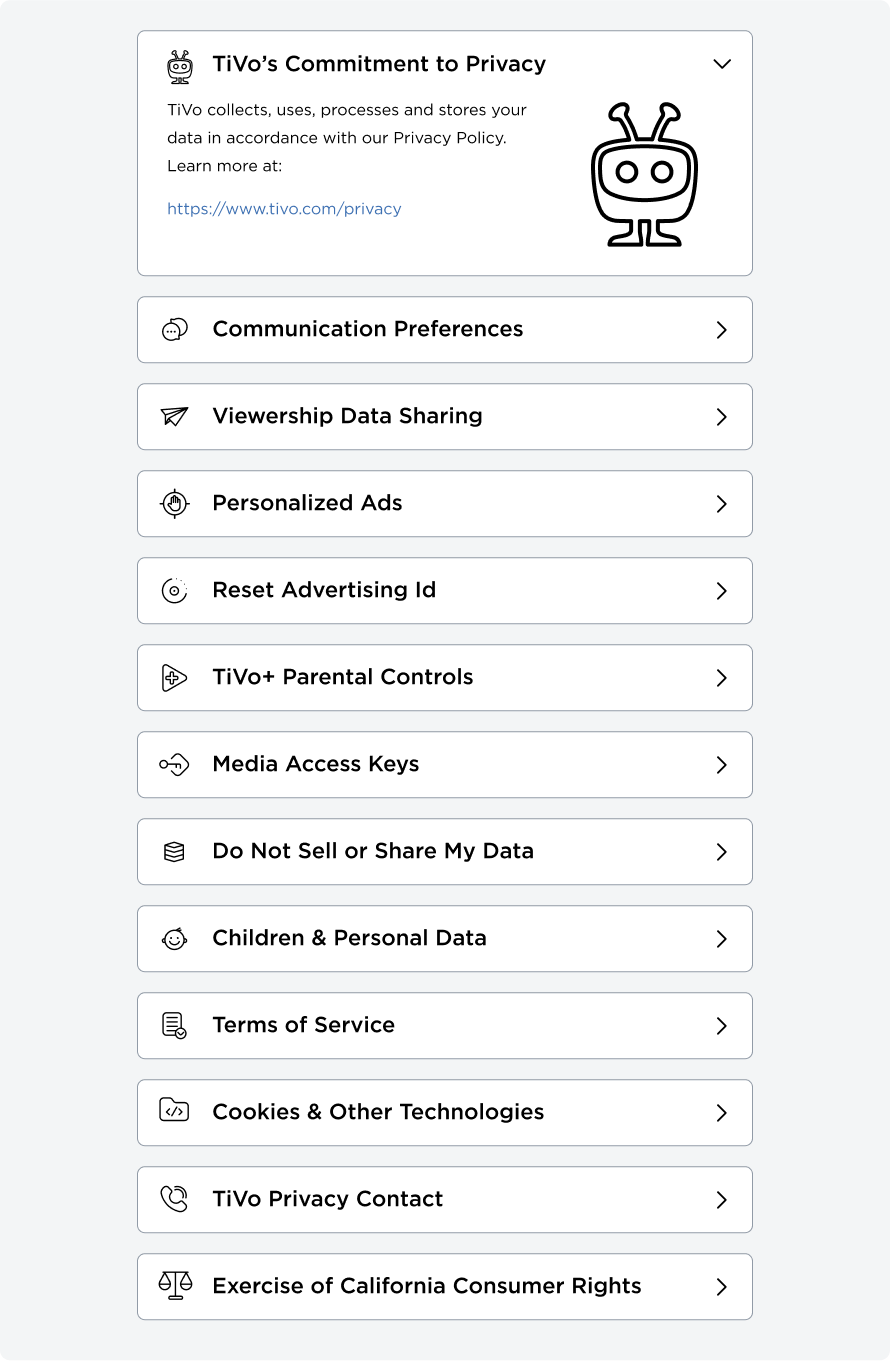
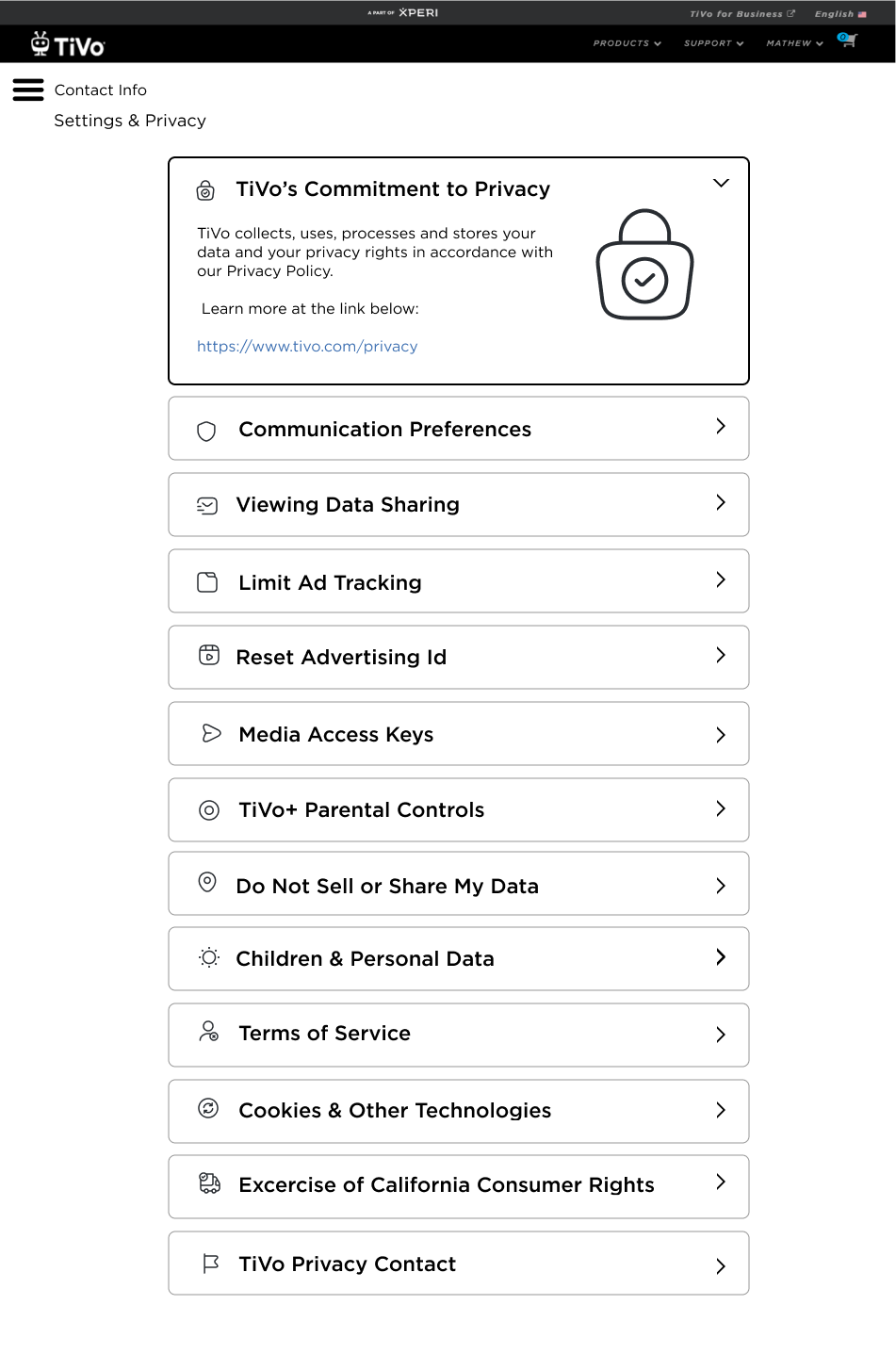
Default View
When the user first comes to the site he can see this section opened by default with an immediate explanation about TiVo commitment to privacy.
-
![]()
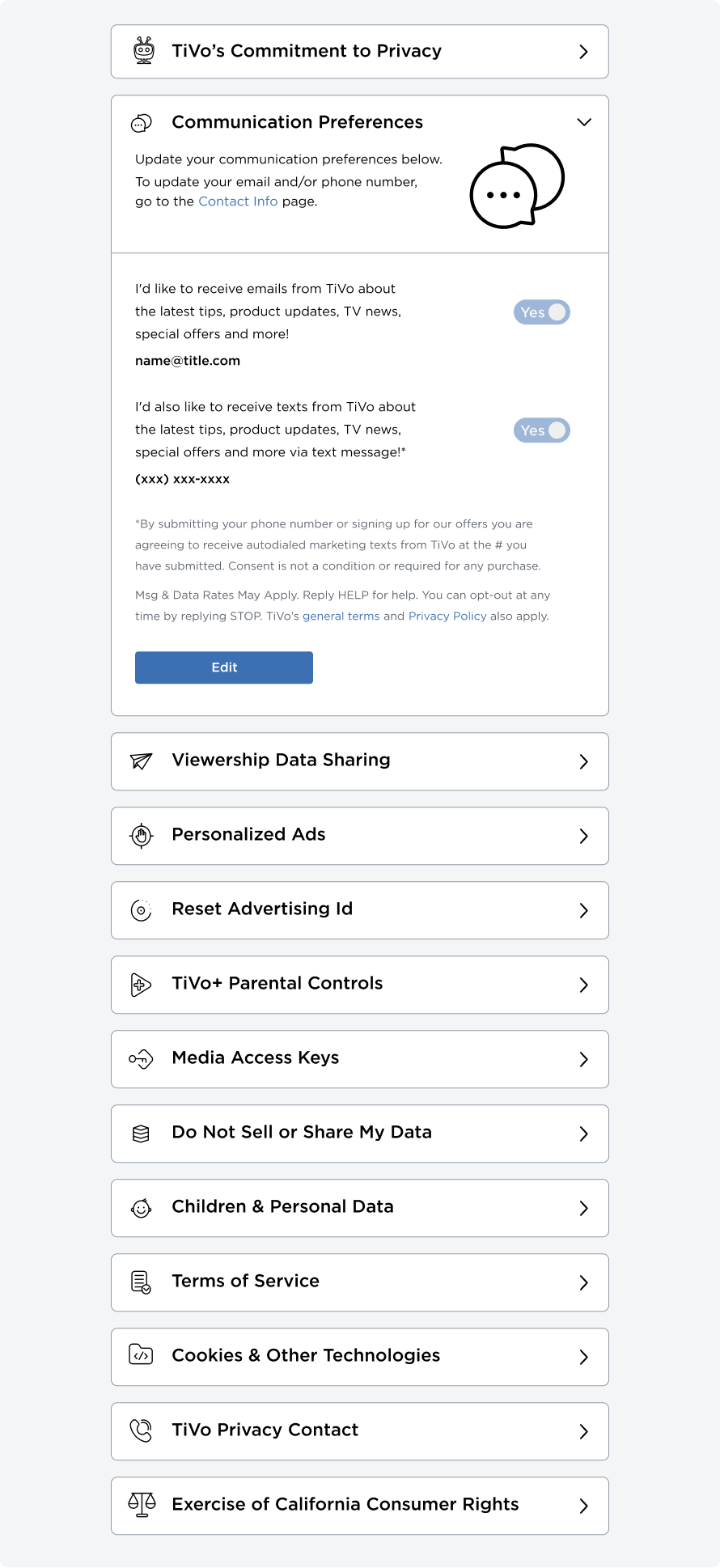
Communication Preferences
The ComPrf is one of the most important settings and defaults to Opt in status. The user can change the default by triggering an Edit flow.
-
![]()
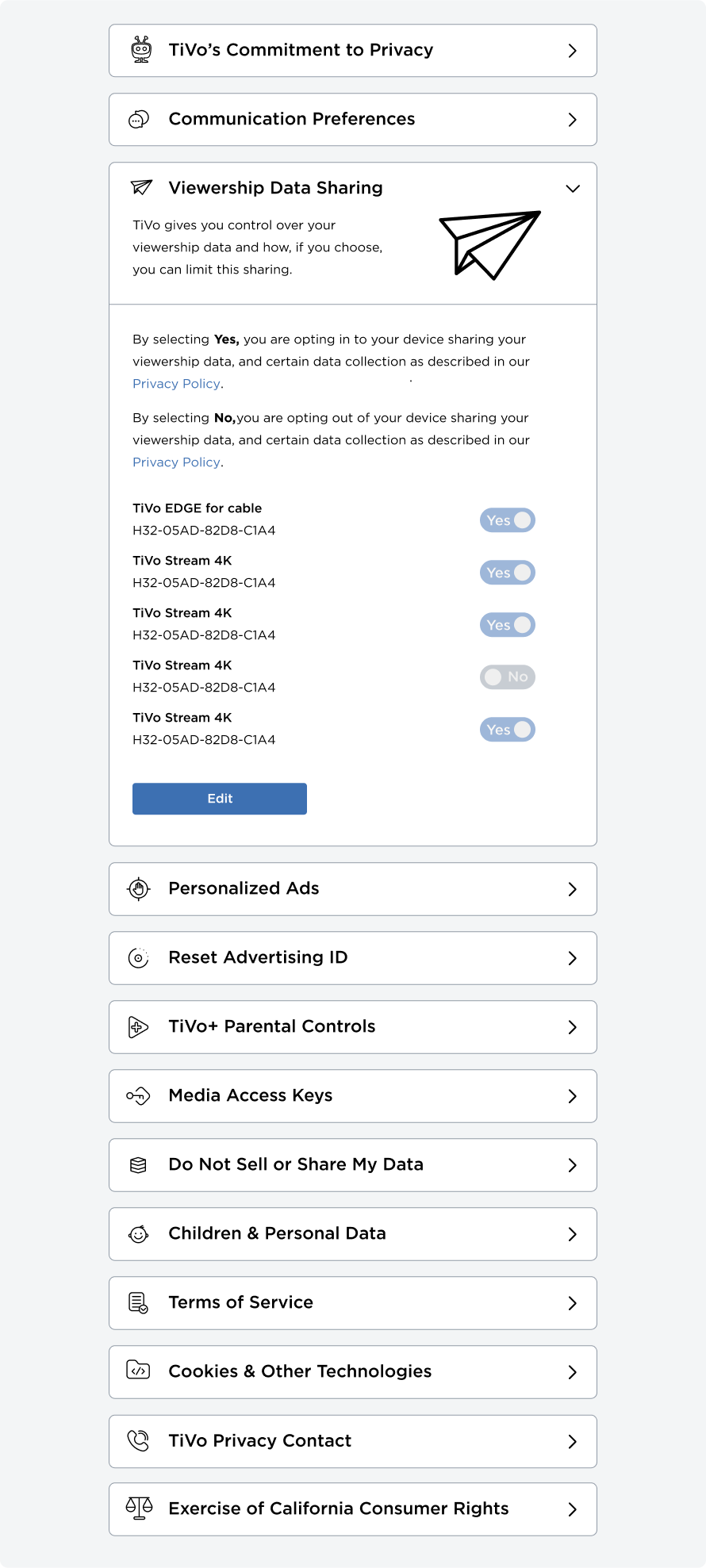
Data Sharing
Data Sharing setting now can be personalized for each device on the user’s account.
-
![]()
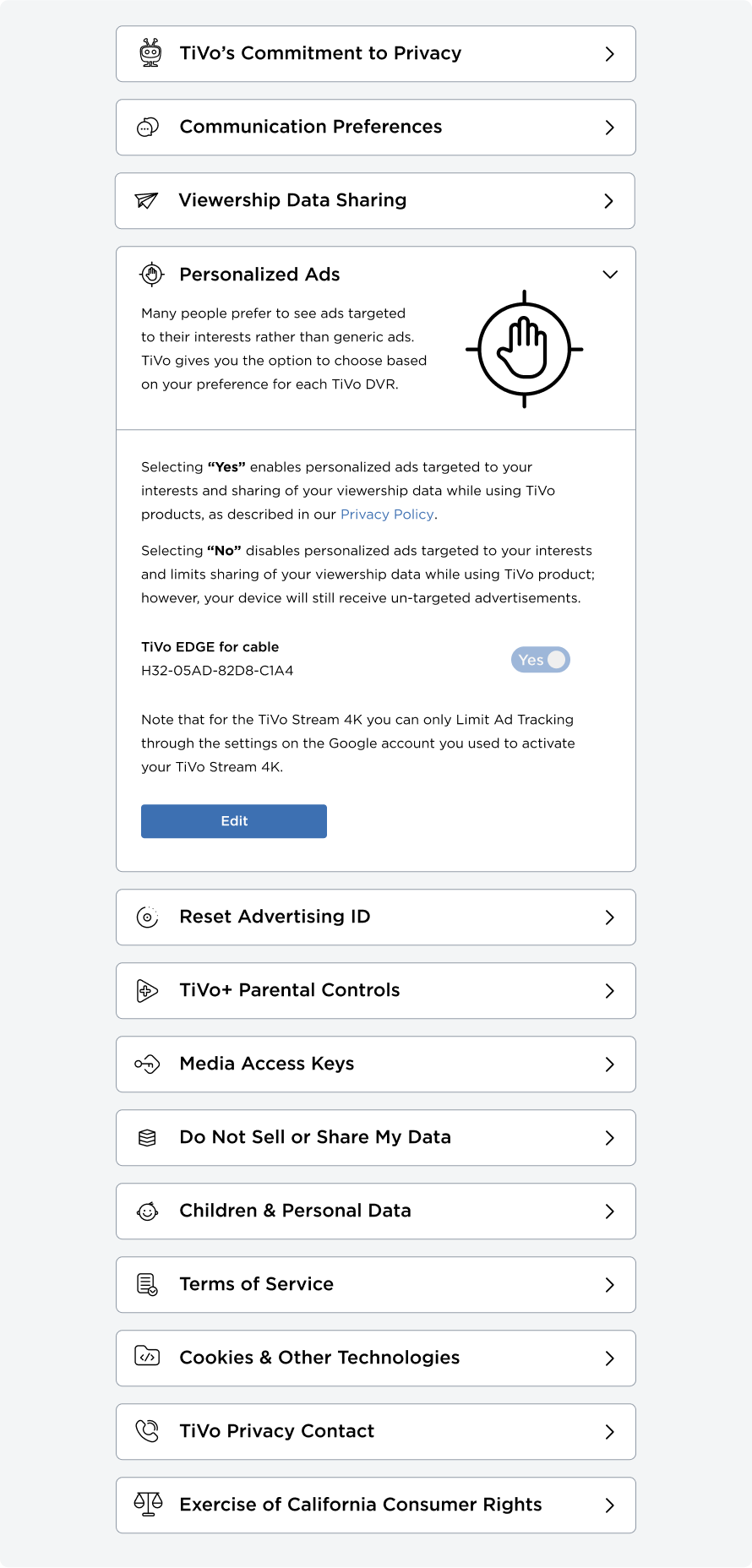
Personalized Adds
Device specific feature where the user can decide which device will or will not receive the adds
-
![]()
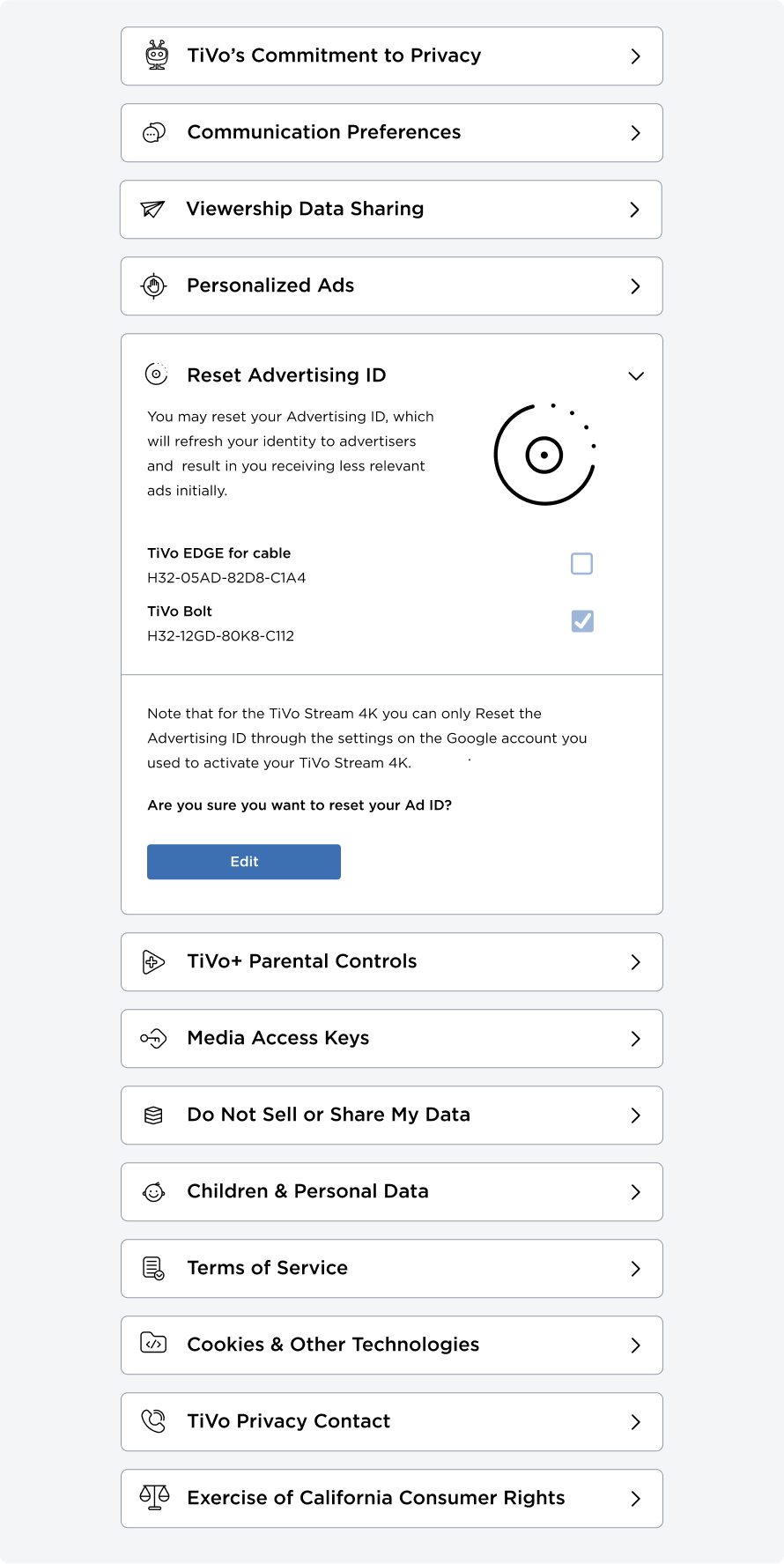
Reset Ad ID
Device specific feature
-
![]()
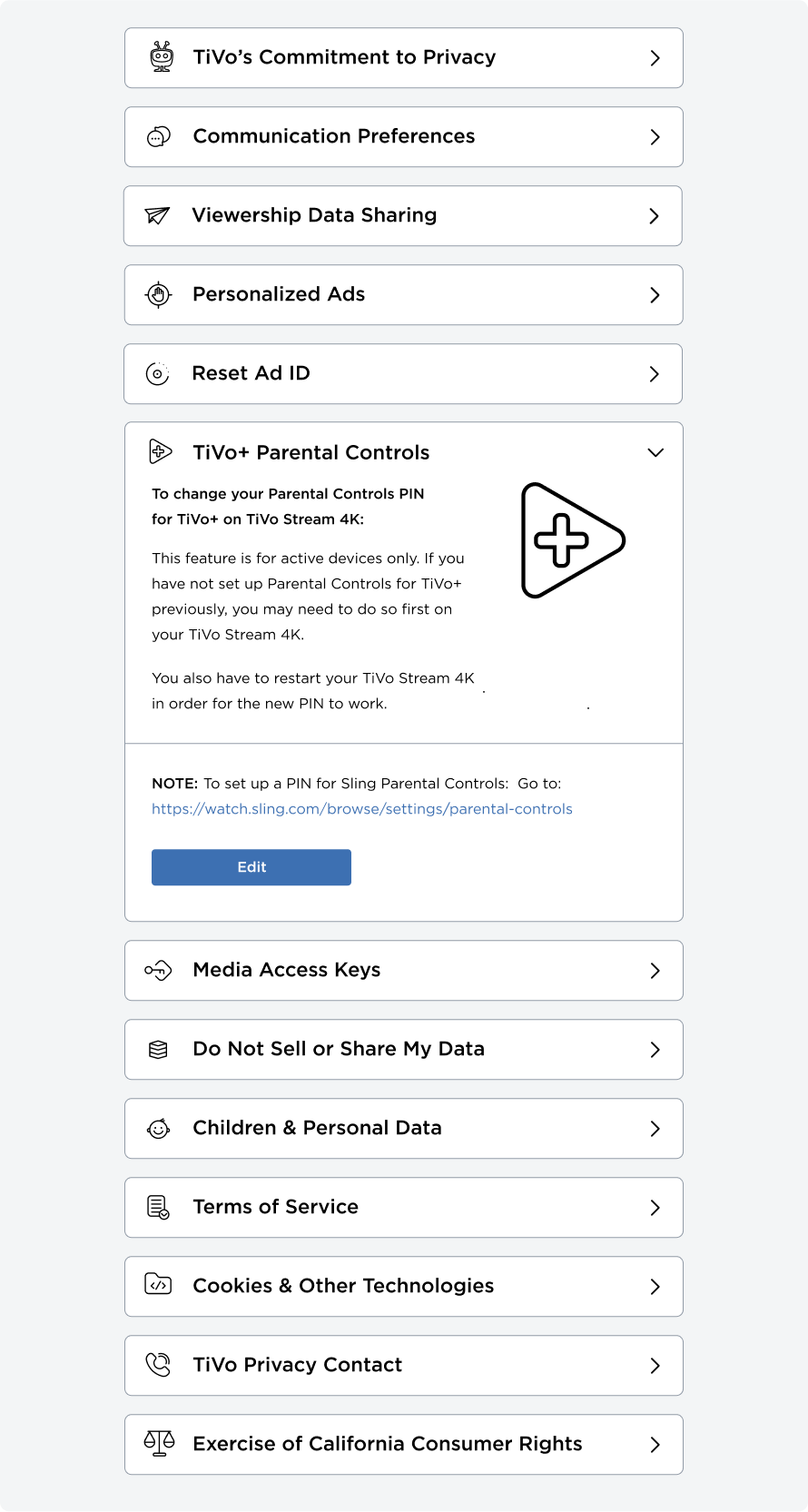
Parental Controls
Finally, users will be able to reset add the PIN to the specific devices from this scree
-
![]()
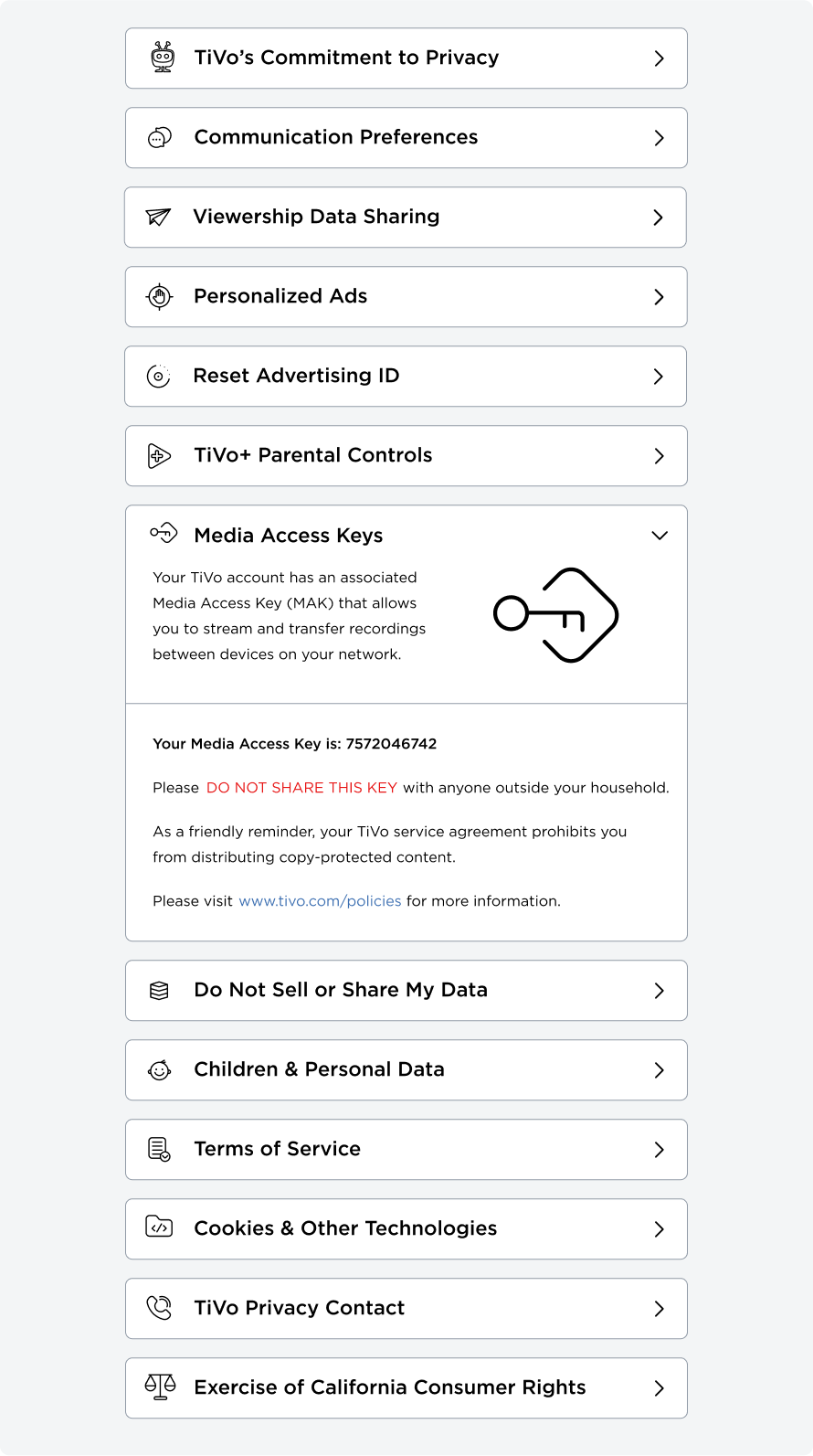
Media Access Keys
MAK rest can be done inline in this section
-
![]()
Do Not Sell
User ca fill out the form through this flow
-
![]()
Children & Personal Data
Description goes here -
![]()
Terms of Service
An informational screen
-
![]()
Cookies & Other Technologies
An informational screen
-
![]()
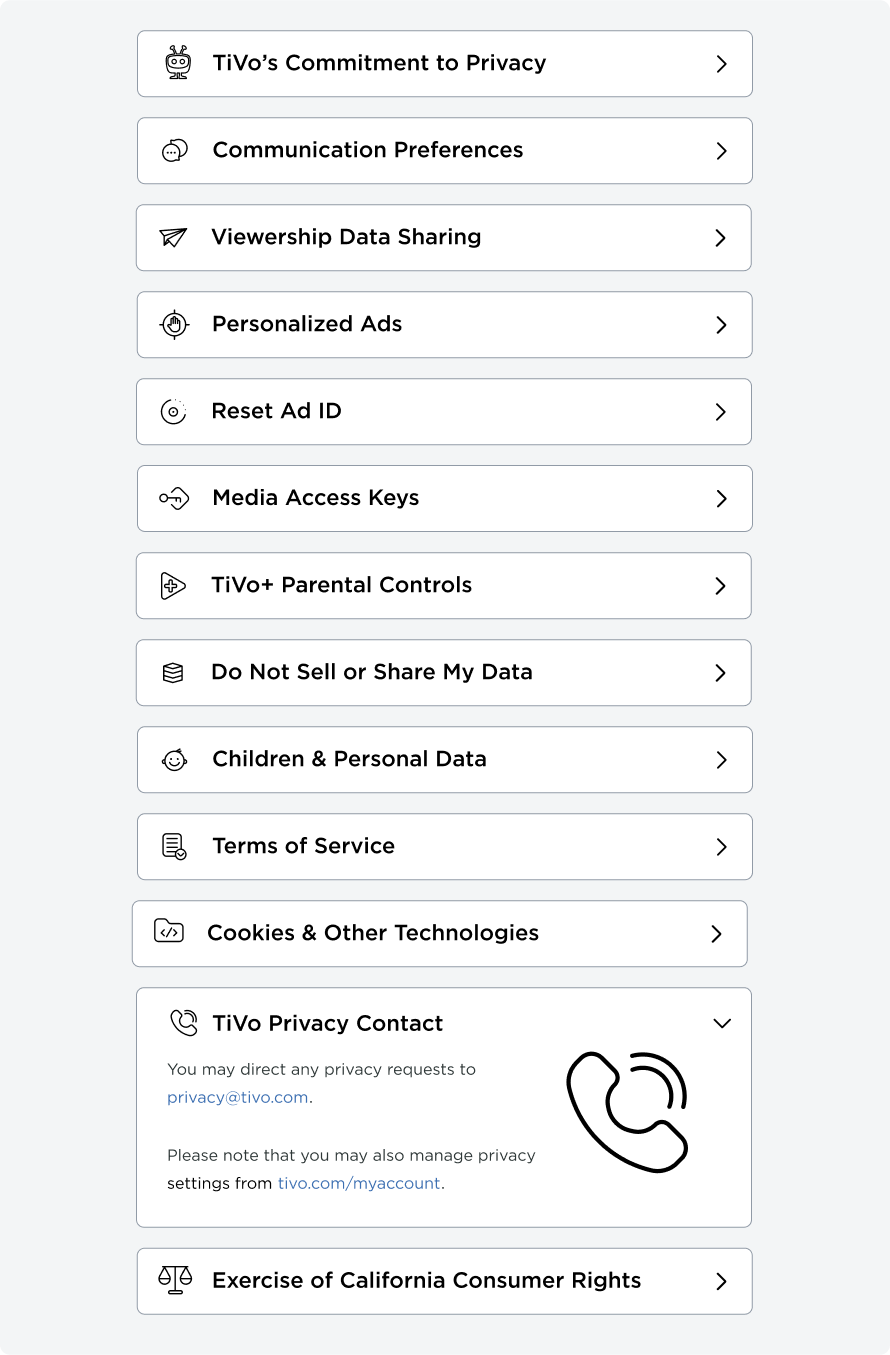
Privacy Contact
An information and contact screen
-
![]()
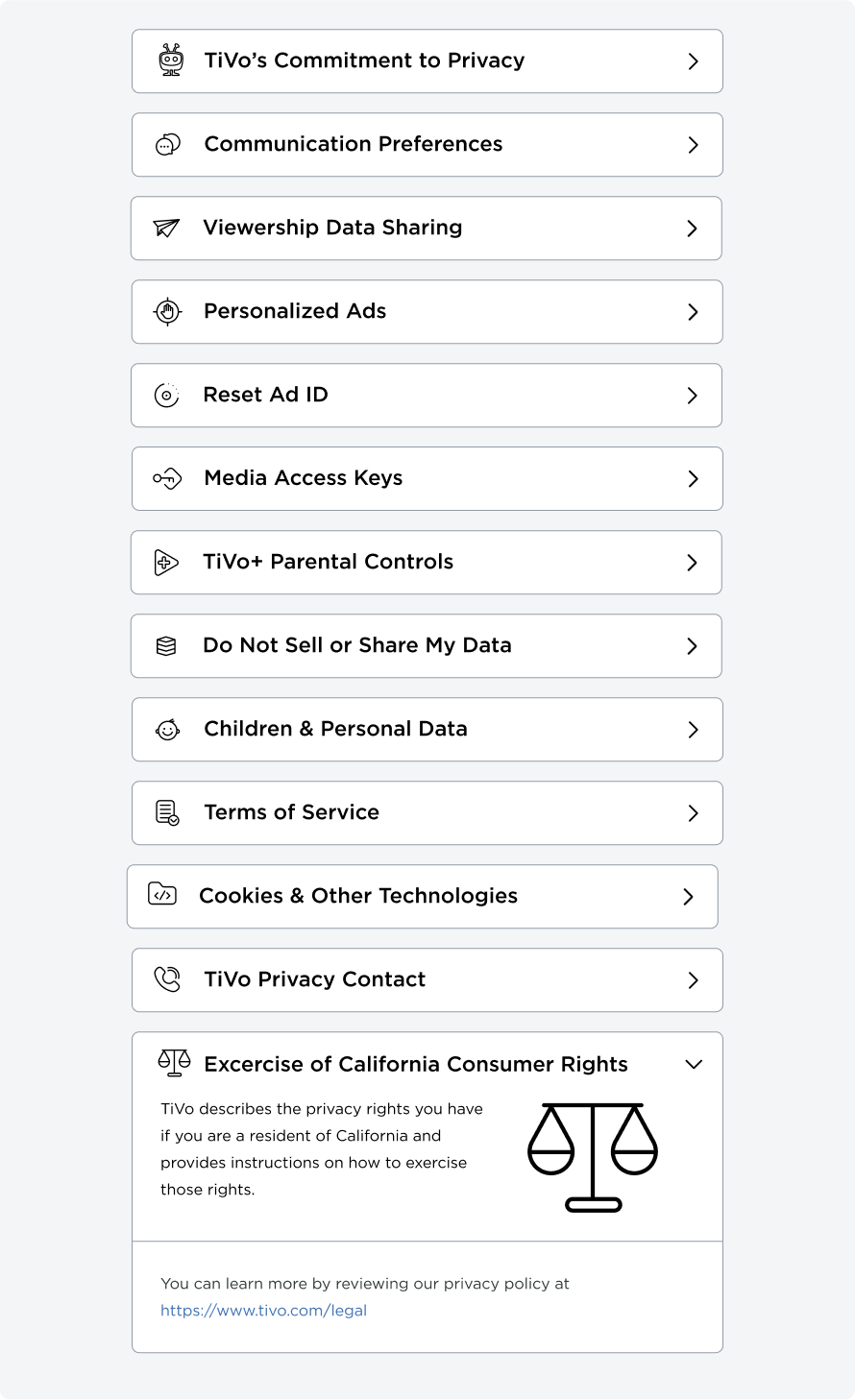
CA Consumer Rights
An informational screen
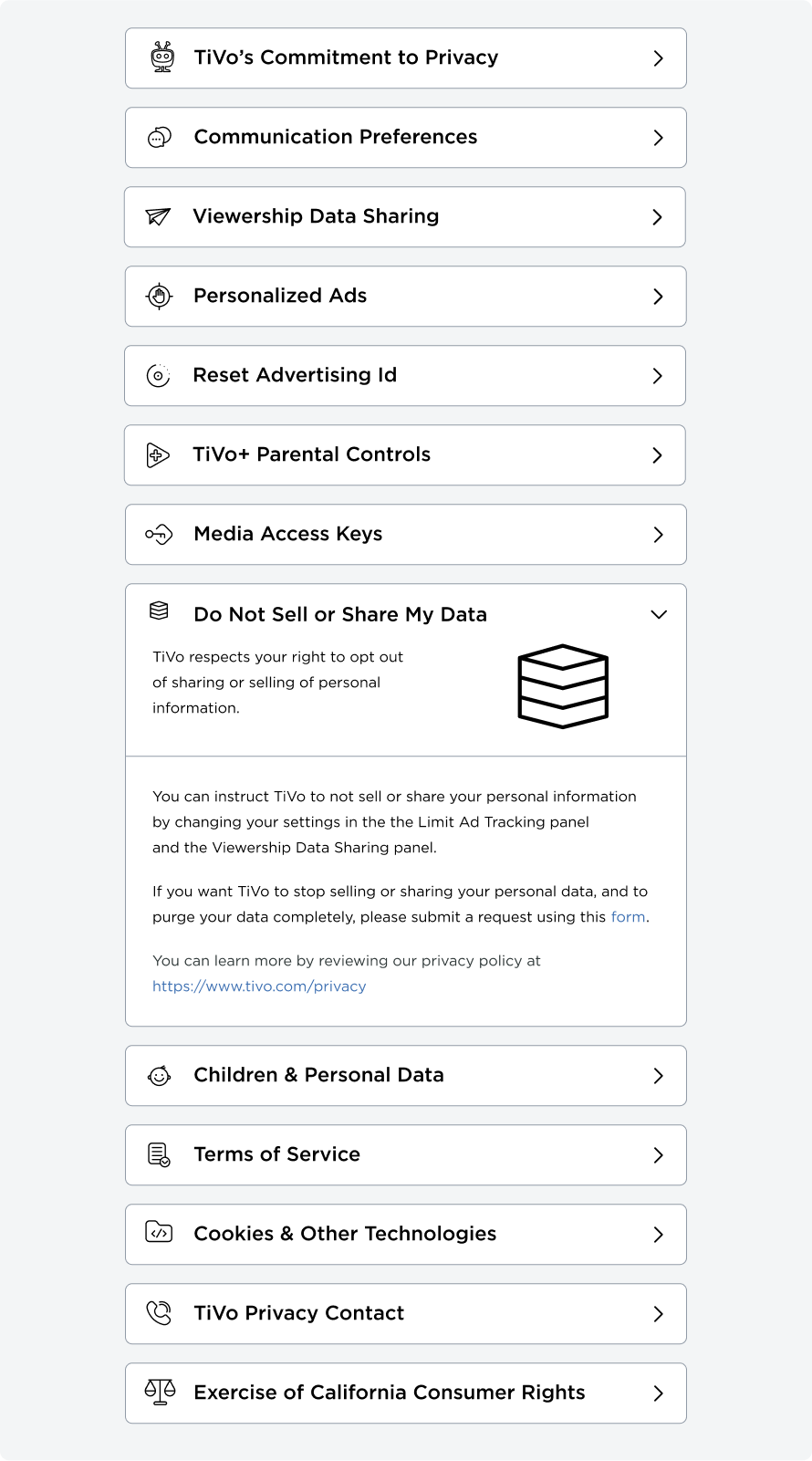
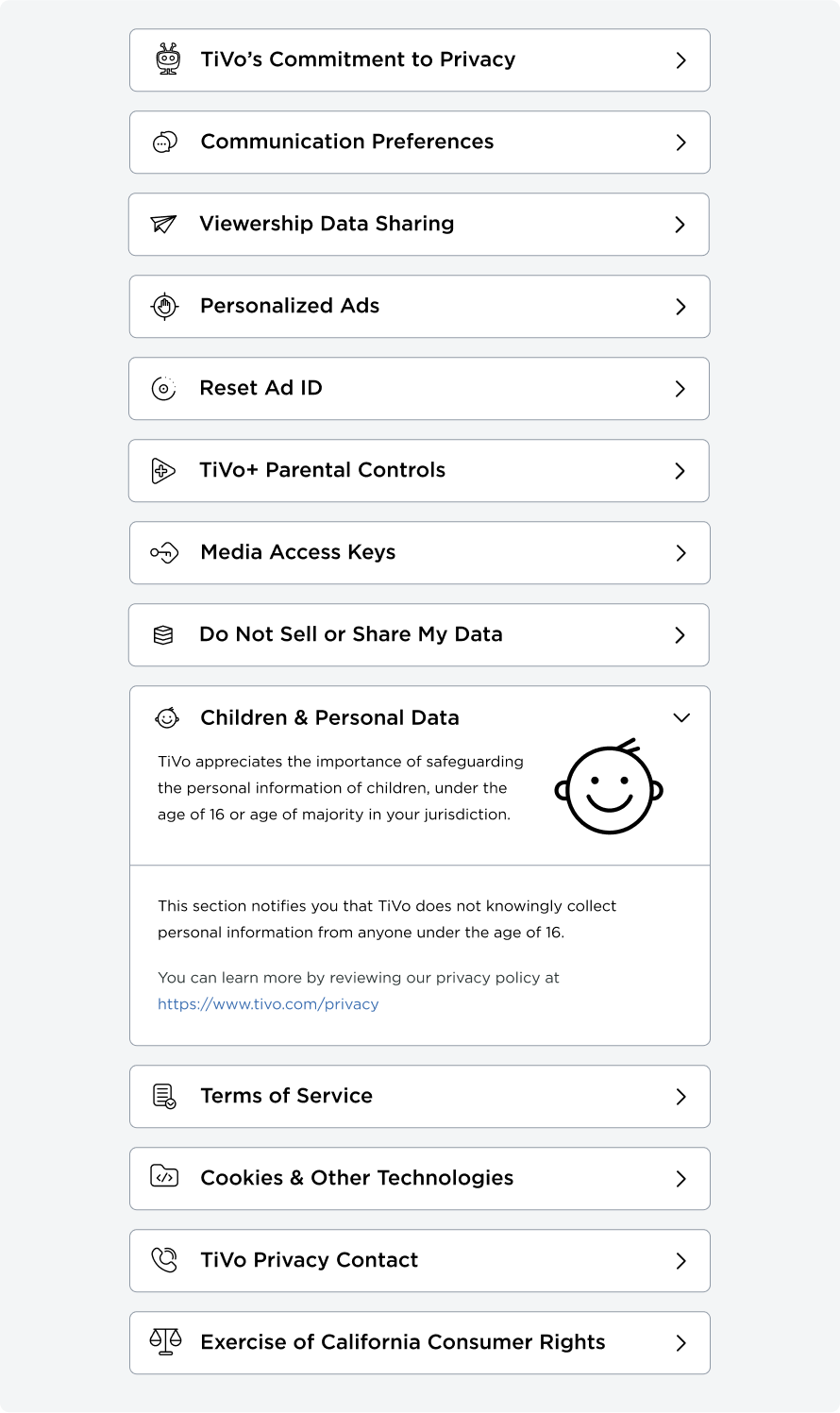
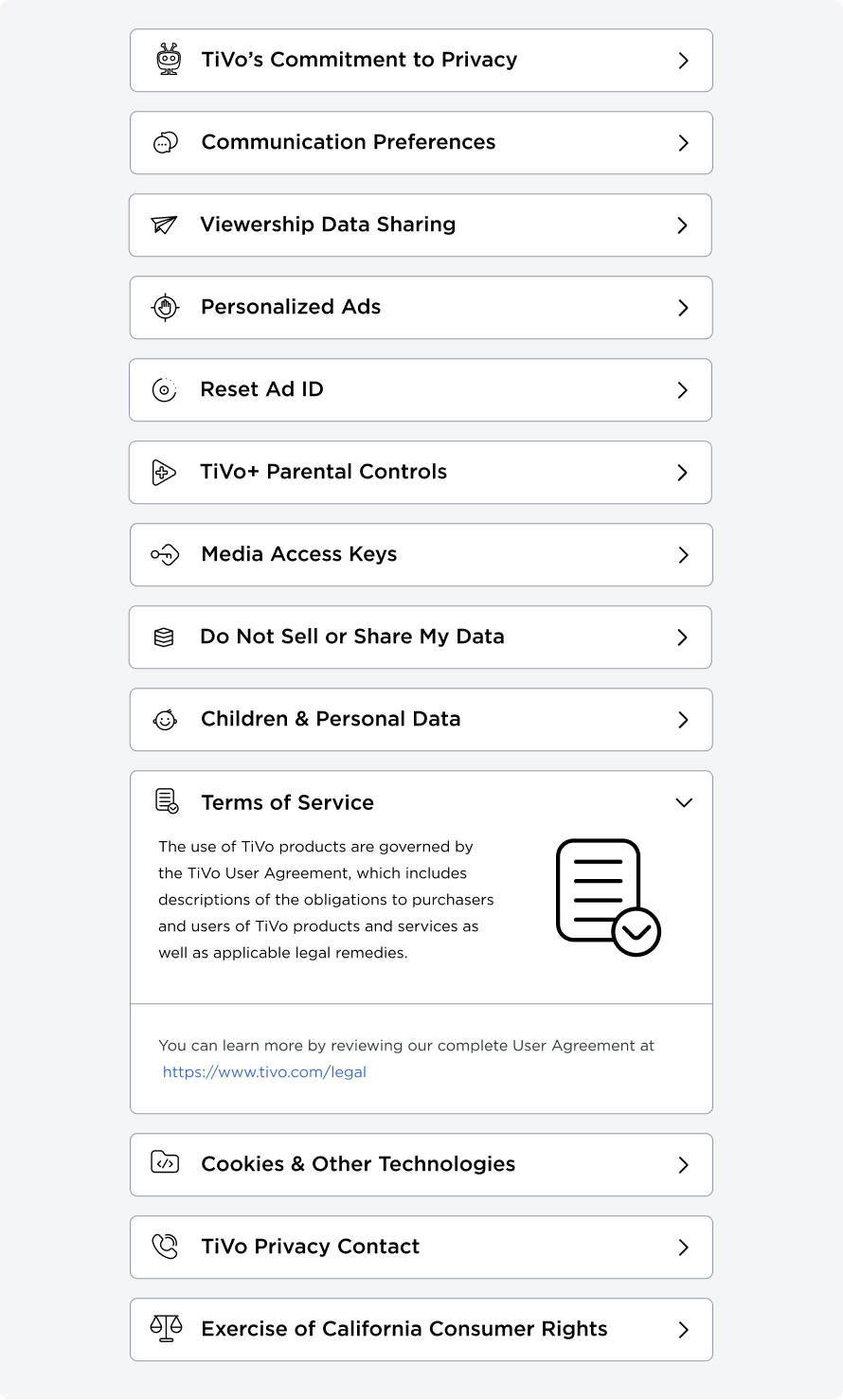
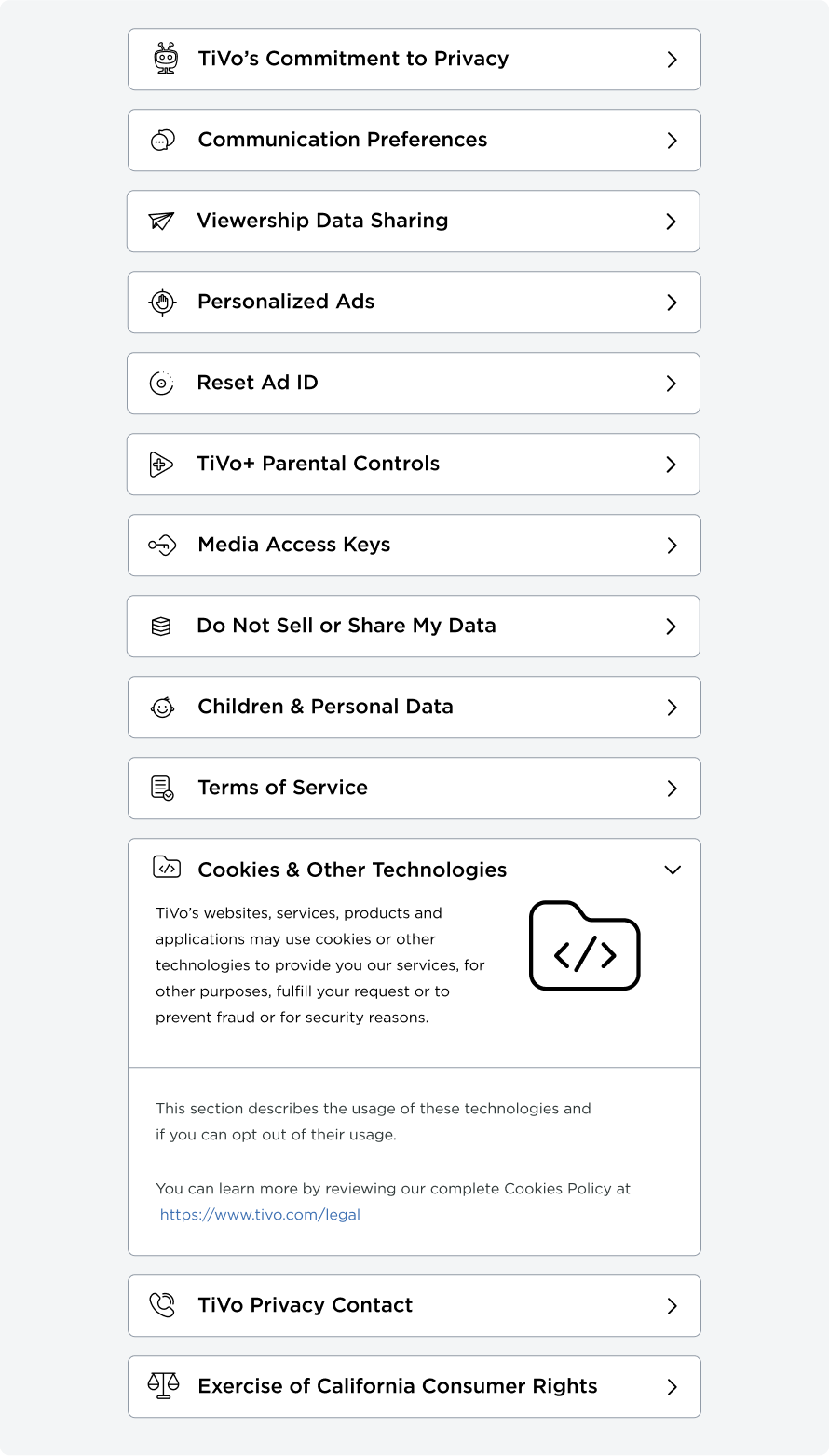
Understanding the problem space: CUSTOMER
In the account creation flow, the communication preferences settings were misleading and failed to offer clear choices. This ambiguity left users uncertain about the implications of their selections (False Dichotomy).
Lack of Clarity

No Modify Capabilities
Furthermore, TiVo users were not provided with options to modify privacy settings and parental controls at the device level. This lack of flexibility means that adjustments couldn’t be tailored to specific needs or contexts, leading to a one-size-fits-all approach that may not have been suitable for all users (Bait & Switch).

Discoverability
Additionally, users often found themselves at a loss regarding the meaning of specific settings due to the absence of clear and straightforward explanations. This absence of clarity impeded the user's ability to make informed decisions about their privacy and content consumption preferences.

Lack of Mobile Optimization
Moreover, the settings were not optimized for mobile use and proved to be impossible to navigate on mobile browsers.
Understanding the problem space: BUSINESS
Low Satisfaction Rates

Low user satisfaction and high bounce rate while trying to use settings and privacy sections.
Lack of Flexibility

Furthermore, TiVo users were not provided with options to modify privacy settings and parental controls at the device level. This lack of flexibility means that adjustments couldn’t be tailored to specific needs or contexts, leading to a one-size-fits-all approach that may not have been suitable all users (Bait & Switch).
Resolution (how might we…)
Ensure customers actively select their opt-in/out preferences to avoid surprises by having simple navigation.
Clearly explain each setting's function to build trust in the TiVo brand by providing an explanatory text next to each setting.
Provide options for device-specific settings management by introducing ‘Edit’ functionality.
Make all pages mobile and tablet friendly to enhance user engagement by designing break points.
Update the design to be modern and appealing by adhering to newly established Manage My Account Design System.
Success Metrics
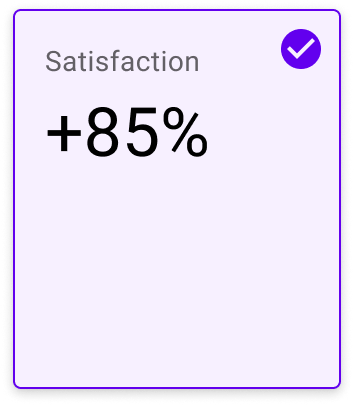
Surveys taken to measure user satisfaction and perceived transparency of how web site handles their data received 85% satisfaction rate.
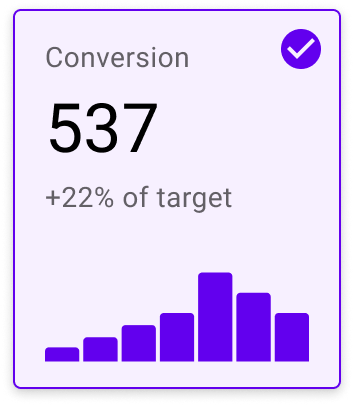
22% increase conversion rate
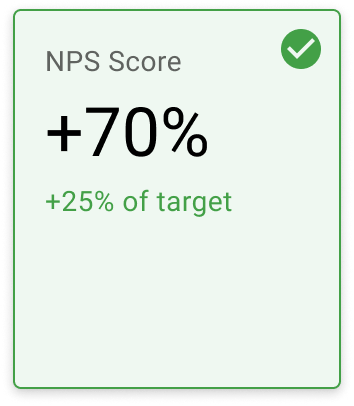
Achieved 70% NPS score.
47% drop in customer support calls (according to customer support survey and analytics group).

To Wrap Up
What I thought was boring and uninspiring turned out to be an exciting journey!
My carefully crafted designs highlighted the importance of user transparency, enhanced the TiVo brand reputation, and ensured compliance with California privacy laws. This effort and my designs demystified privacy for users, showcasing TiVo’s and my own commitment to their rights and boosting our ethical standing.
My design approach and strategy also aligned TiVo with global regulations, protecting both users and the company. This project proved that prioritizing user needs and legal compliance is a strategic move that builds trust and strengthens our brand. It also proves that learning anything, even if it’s about privacy laws, is useful and empowering.
The design ‘template’ strategy that I created is very scalable and will be very useful when TiVo adds tough foreign privacy policies when other TiVo products hit the global market.
What Could Be Done Better
Even though the project was a huge success and post launch numbers prove the dramatic drop in customer support calls and significant rise in adoption rates, in hindsight, the urgency with which we approached our project led us to bypass several crucial steps in the design process, a decision I somewhat regret. As a Product Designer, I understand the value of a meticulous, step-by-step approach to ensure that every aspect of the product is user-centric and fulfills the intended design goals.
Skipping these stages meant overlooking opportunities for refining our concepts through user testing and iterative feedback which could have significantly enhanced the final outcome. The rush compromised not only the depth of our user research, but also the potential for innovative solutions to emerge from a more thoughtful and comprehensive process.
This oversight has been a poignant reminder of the importance of not sacrificing the quality and integrity of the design process for the sake of expediency. It's a lesson learned the hard way, emphasizing that true innovation requires time and patience, and the most effective solutions arise from a process that respects each critical step.
‘Minimalism is not a lack of something. It's simply the perfect amount of something.’― Nicholas Burroughs
but just in case you were wondering about the imperfect amount of something - below is my ‘Design Kitchen’
Design Kitchen
Below are the technics and processes used in the development of final designs.
-
I began this project by defining key research goals:
To understand how users interact with device specific settings and how they set them up
Provide the right hierarchy or settings
To understand optimal set of settings for the US and other countries
-
Needs:
Clear and concise explanations of the new privacy laws
User-friendly interface for updating privacy settings
Transparent information about data collection and usage
Frustrations:
Struggling to understand the new privacy laws
Feeling overwhelmed by the complexity of the Settings & Privacy section
Worried about the potential consequences of non-compliance
Concerned about the security of personal data
-
1. Educating users about the meaning of each privacy setting and the actions they can take regarding it was deemed important by 89% of respondents.
2. Allowing user reset device specific settings was a key point of visiting Settings & Privacy subsection of Manage My Account section on TiVo.com.
3. Users prefer to utilize mobile and tablet to do activities such as reviewing Settings and Privacy.
-
Keeping Sashi (User Persona) needs in mind, I created a user flow diagram where the key screens and interactions were identified with the goal of accessing privacy policies and setting up device specific rules. By mapping these pathways out, I was able to define the required screens and develop a logical flow for 3 types of devices: Stream 4K, New DVR users, and Existing DVR users.
-
Once the general skeleton of the site was set, I considered how a user might engage with each screen to complete certain tasks.
My Role
End-to-end Lead Product Designer / Product Liaison
I revitalized the dull aspects of privacy laws, making them more engaging with iconography and a mobile-first design, including concise descriptions for each law.
I implemented a user-friendly design for personalized device settings. This scalable design accommodates future international laws related to other TiVo products.
In enhancing the design, I prioritized ethical considerations: merging business objectives with customer privacy concerns into a transparent solution. This approach not only respects user autonomy by making informed consent a cornerstone of the user experience but also aligns with business interests by fostering trust and loyalty. By ensuring transparency and ethical handling of data, the my designs champion user rights while supporting business growth.
Before
After

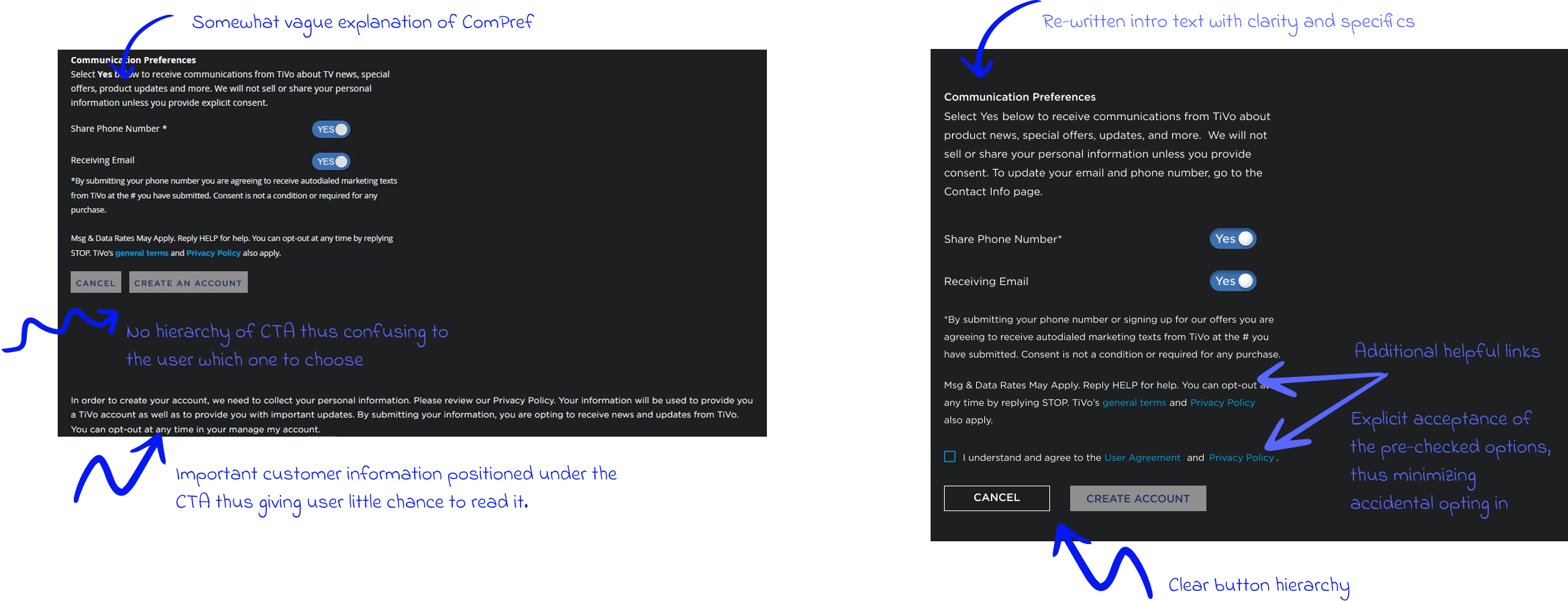
During the account creation process users were automatically signed in to receive the communication without giving proper consent.
User Painpoints
Pain Point 1
Design Solution 1
I added clarify through the explanatory text
I introduced a checkbox for explicit opting in to avoid accidental actions
I significantly improved on CTA hierarchy through creation of button hierarchy in Design system
I introduced the idea of adding clearly visible helpful links
User absolutely couldn’t change settings on individual devices.
Pain Point 2
I provided the design solutions that would allow user to change privacy settings on any device. These: Viewership Data Sharing, Personalized Adds and Reset AD ID.
Design Solution 2
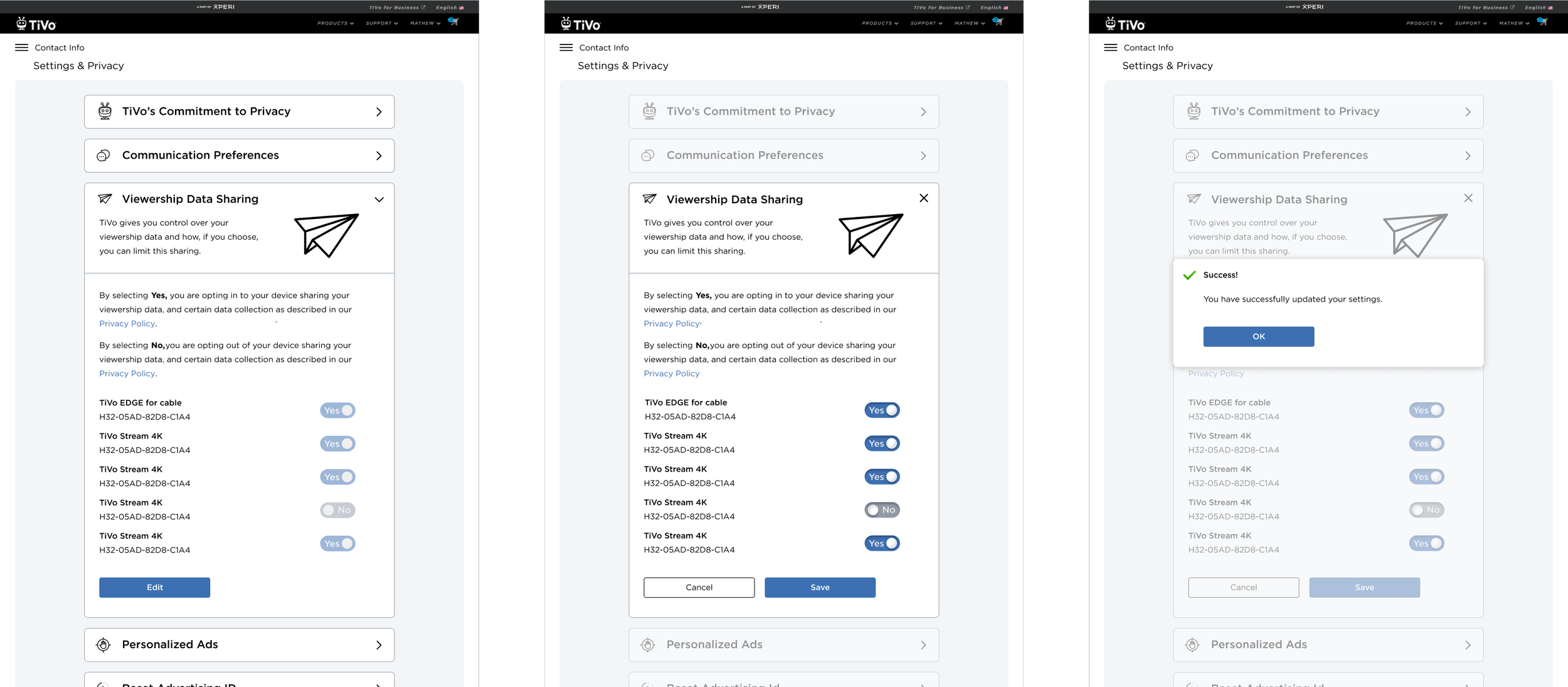
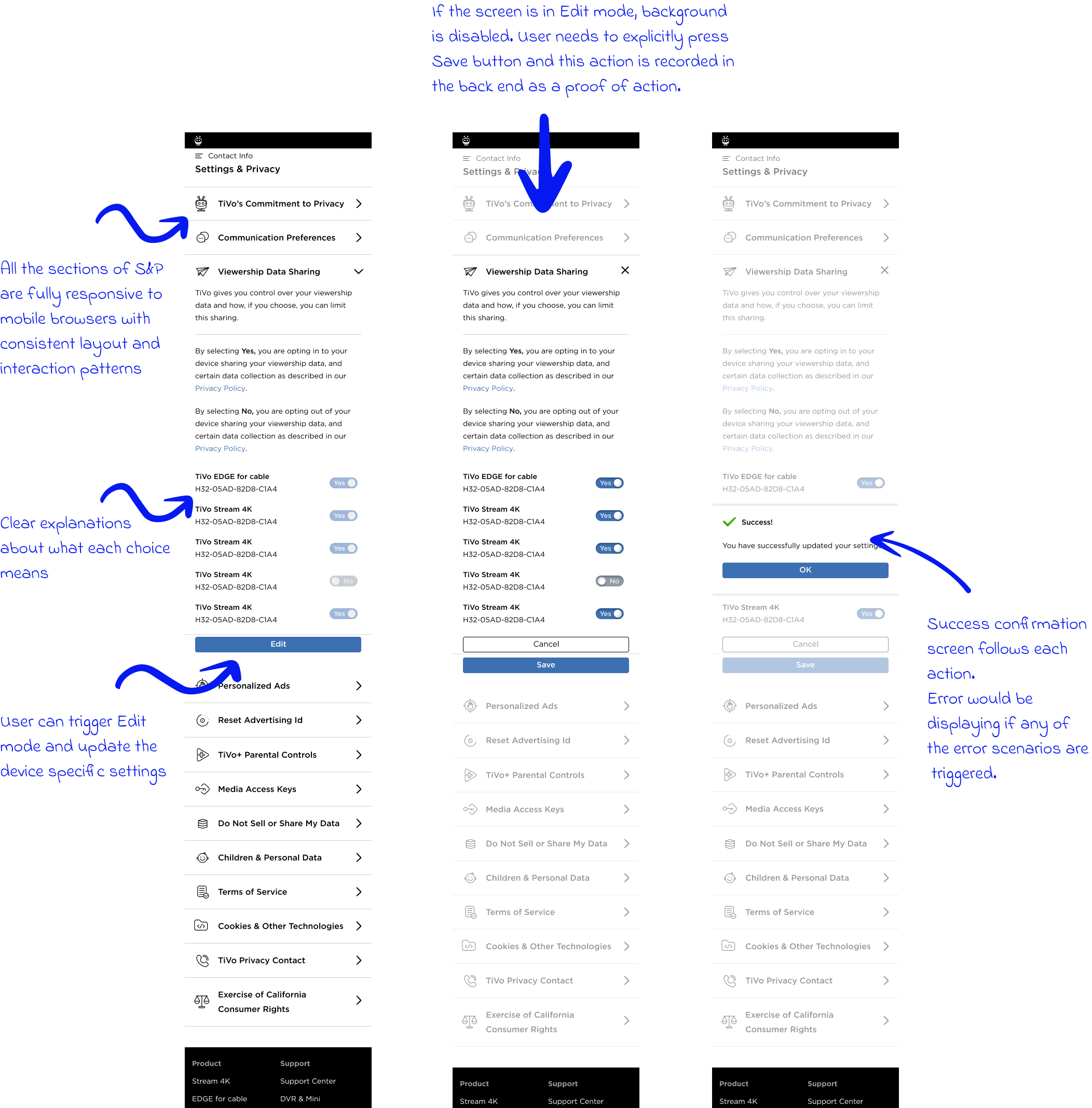
Since about 60% of TiVo.com customers are using a mobile device to do account management related activities, it is impossible for them to interact with the Settings and Privacy section in the current implementation.
Pain Point 3
My design solution adeptly addresses the diverse array of user screen resolutions by employing a beautifully crafted responsive design framework. This approach ensures seamless user experiences across all devices, fulfilling our commitment to accessibility and engagement at every touchpoint.
Design Solution 3
3 design options were presented to the stakeholders
-
![]()
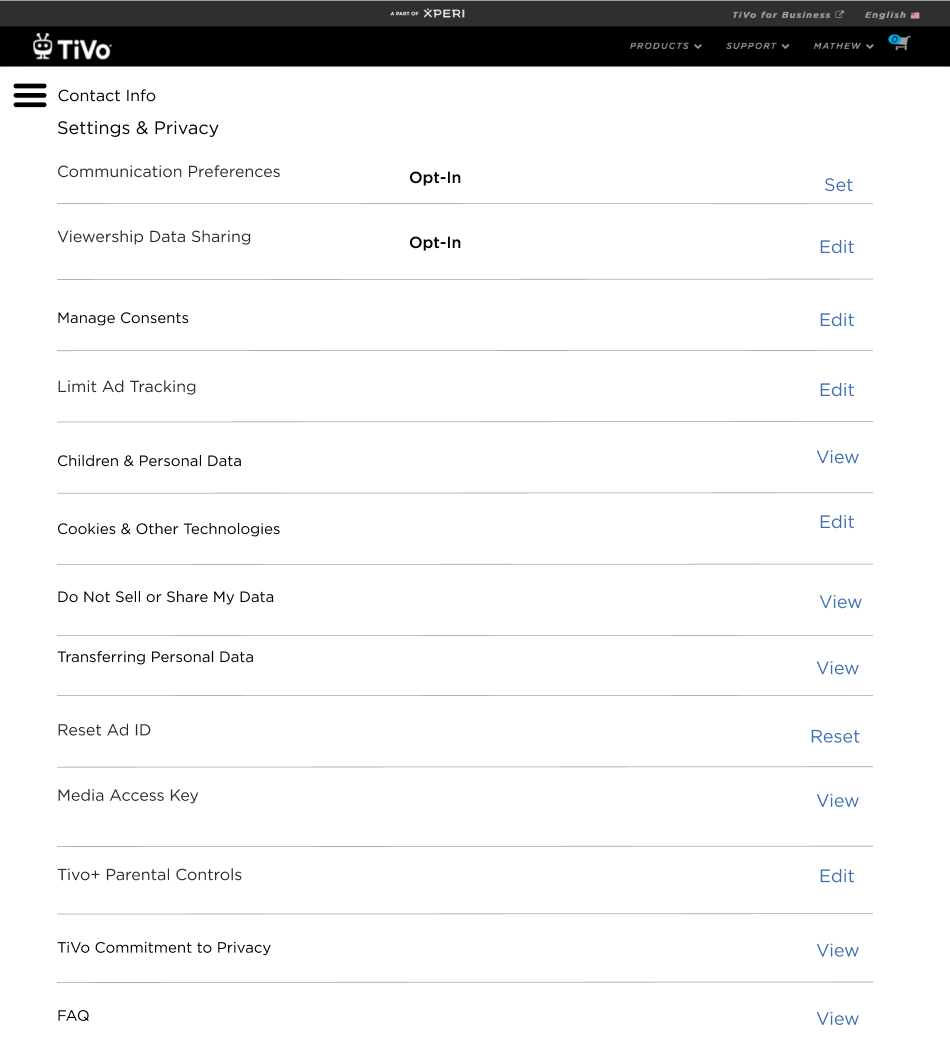
Settings & Privacy V1
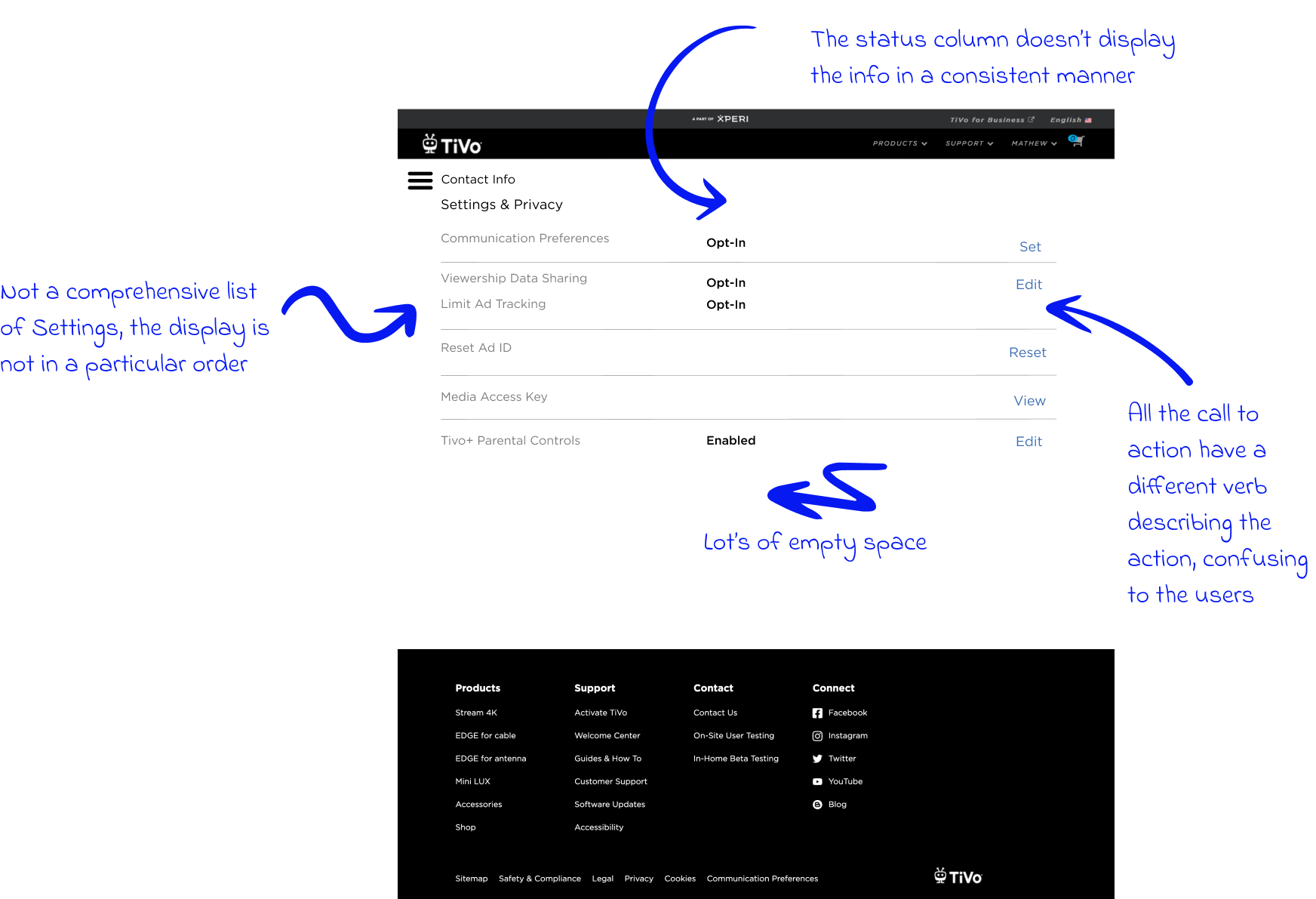
My idea 1 is based on existing structure where each subsection is visible in the list and the status is displayed in the center column.
-
![]()
Settings & Privacy V2
My other option doesn’t display the show metadata. It is focused on the channel metadata at the top and scheduled shows.
-
![]()
Settings & Privacy V3
This idea was based on mobile first concept and a clear separation f all the settings with an explanation what they mean.
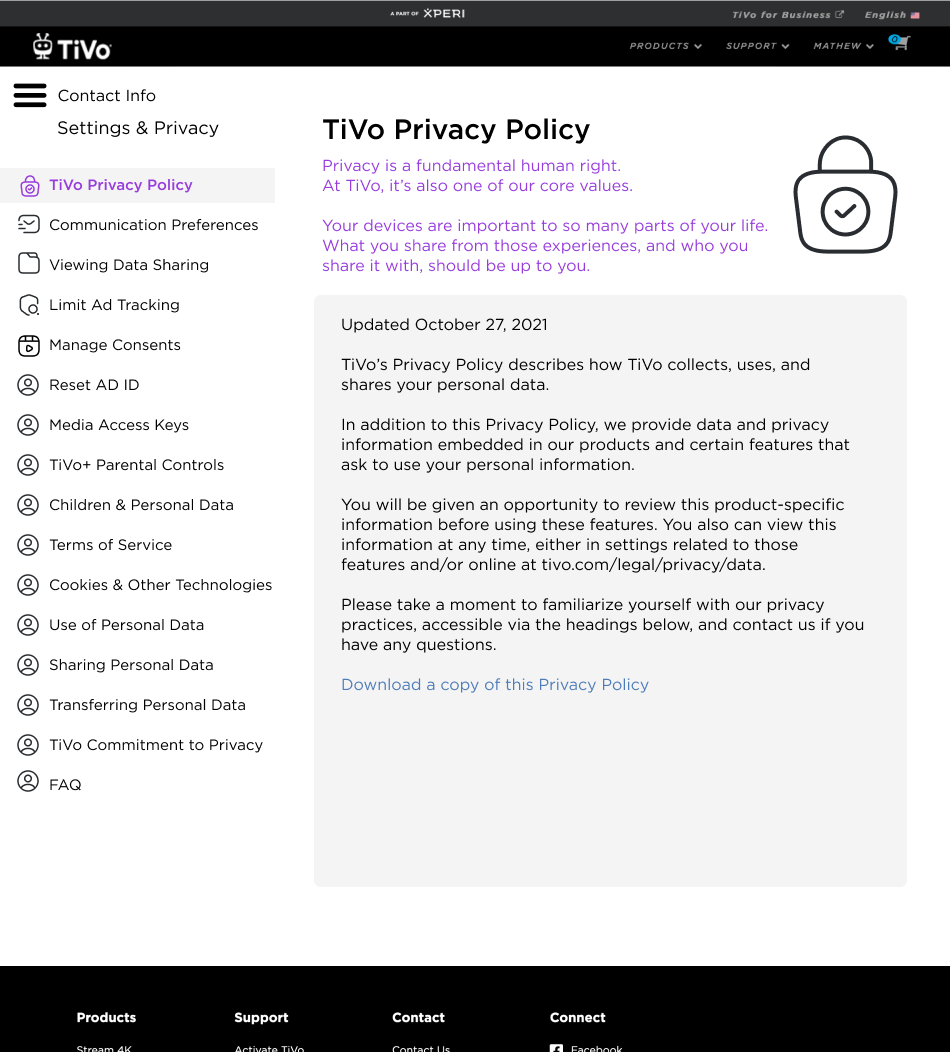


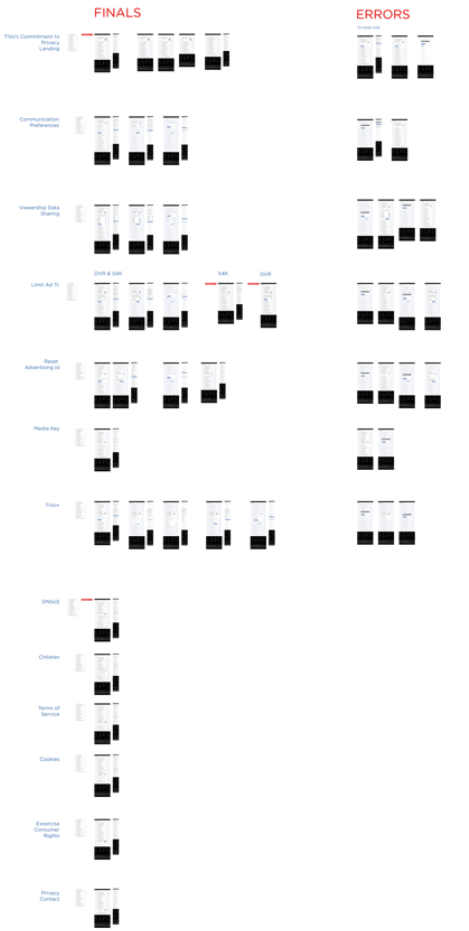
Design Boards
Following the selection of design version 3, I embarked on an extensive creation phase, producing multiple design boards and wireframes. These materials comprehensively covered all existing use cases, ranging from user interactions to editing device specific settings, assigning parental control pins to specific devices, error messages displays and other significant design nuances.