About Rufina Shteynberg
I was born and raised in Moldova, where my family settled after my grandparents fled Nazi occupied Romania. Despite my parents being prominent Refuzniks, my childhood was beautiful—filled with immense love and surrounded by mind-bogglingly fascinating people and events. I draw much of my current imagery from these formative years, channeling both the stories I inherited and the history I witnessed with my own eyes.
My formal education began in Moldova's capital, Kishinev, where I attended art school and college, receiving a classical education in fine art and art history. I still vividly remember our late-night group outings, braving the freezing winter darkness to sketch and paint at abandoned factories and the local railway station. It was during these exhilarating times that I first fell in love with printmaking.
When we immigrated to the United States, I continued my printmaking studies at San Jose State University. However, as the digital era exploded, I found myself drawn to the emerging worlds of graphic and web design. After expanding my studies into multimedia, I channeled my creativity into a long, rewarding career in product design.
Now, a new era begins. I am returning to the physical canvas and the press, picking up exactly where I left off—but carrying the perspective of a changing world and a matured self. I still have so many beautiful visual stories left to share.
My art & printmaking process
My artistic process is a balance of deliberate exploration and intuitive freedom. When a concept is visually clear, I translate it directly from my mind to the material, usually starting with a foundational layout in my sketchbook. If an idea is still evolving, I dedicate time to research and visual exploration, slowly gathering the necessary shapes, poses, and missing elements.
I highly value patience in my practice. If a piece feels incomplete once it hits the surface, I put it aside. I return to it periodically to look, think, and wait. Experience has taught me that the final pieces of the puzzle will inevitably lock into place once the work has matured.
Alongside this structured approach is a need for pure spontaneity. There are moments when I simply want to carve, paint, or scribble on a surface. Whether these experiments remain raw or evolve into finished pieces, they represent the core of my existence so to speak: total, uncompromising freedom.
Some samples of the process

Sketch w markers

Drawing on a lino

Lino plate is carved
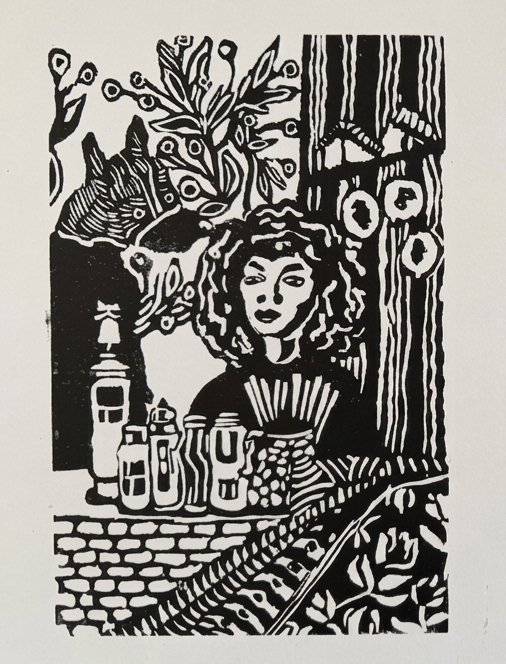
BAT print in B&W

Hand colored with LYRA pencils

Sketch w prisma pencils and pastel chalk

Lino plate is carved

BAT print in B&W